From Manual Investigations to Intelligent Workflows
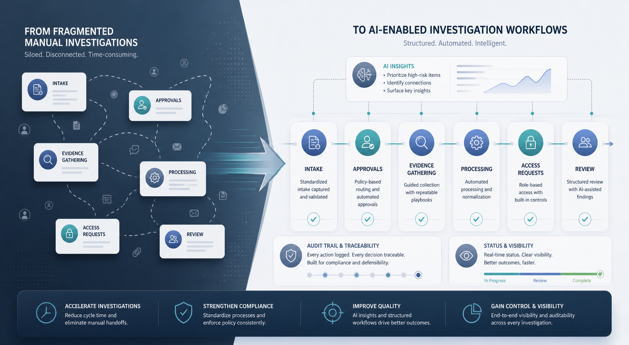
Companies rarely struggle with digital investigations because they lack tools alone. They struggle because the work sits across too many disconnected steps, too many manual handoffs, and too few people who can own both the operational workflow and the technical delivery behind it.
This is where investigations slow down.
An intake arrives by email or form. Someone triages it manually. Approvals move across teams. Access has to be requested. Data preservation and collection depend on specialist knowledge. Processing capacity becomes a bottleneck. Reviewers lose context between systems. Status updates depend on chasing people. Auditability is fragmented. And when pressure rises, the whole process depends on a handful of experts keeping it moving.
For many organisations, this is the real challenge: not just running investigations, but turning investigations into a repeatable, governed, scalable service.
At DataExpert, these solutions are supplied by our Advanced Solutions business unit. Advanced Solutions helps clients move from manual investigation operations to automated, AI-enabled workflows for real-world legal, forensic, compliance, and response teams.
Why manual investigation workflows break down
Most organisations do not start with a clean operating model. They inherit a patchwork of tools, workarounds, approvals, storage paths, review steps, support arrangements, and access processes. Over time, this creates a delivery model with a few predictable problems:
• intake and approvals are handled in one place, while collection, processing, and review happen somewhere else
• preservation and collection workflows are only partly automated, so specialists step in manually
• reviewer access is slow, inconsistent, or dependent on service desk intervention
• processing throughput is constrained by fixed infrastructure or static capacity planning
• case teams have poor visibility into status, priorities, and next actions
• support quality depends on whether the provider understands the investigation context, not just the platform
The result is not only delay. It is uncertainty. Teams lose the ability to predict turnaround times, prioritise confidently, and scale when multiple large matters arrive at once.
Consider a common example. A sensitive investigation request is submitted. The case needs triage, approval, preservation, collection, processing, reviewer access, and downstream handoff. But each step sits with a different team or in a different system. One person chases approvals. Another handles access. A specialist runs collection manually. Processing waits for available capacity. Reviewers receive access without enough case context. Status updates depend on email, chat, or service desk follow-up. Nothing is fully broken, but nothing moves as one workflow either.
This is exactly the type of operating model that creates avoidable delay and inconsistent delivery quality.
The capability gap is usually both operational and technical
This is why many automation projects stall. A company may know it wants more automation and wants to use AI, but still lack the combined capability to design, build, operate, and support the full workflow end to end.
That takes more than software.
It requires a partner that understands how to connect:
• case intake and structured request capture
• triage and approval routing
• preservation and collection workflows
• processing orchestration
• reviewer access and role-based permissions
• audit logging and operational visibility
• downstream handoff to review or response teams
• service support, monitoring, and ongoing optimisation
If these elements are treated as separate projects, automation stays partial. If they are designed as one operating workflow, the investigation function becomes faster, more reliable, and easier to scale.
Where DataExpert Advanced Solutions fits
DataExpert Advanced Solutions helps organisations build the full delivery layer around investigations.
We design and implement automated workflows that connect the business process to the technical process. That means establishing the operating model, building the workflow, automating the handoffs, integrating the collection and processing path, managing access flows, and supporting the service in production.
In practice, that includes capabilities such as:
• workflow-driven intake, case registration, and approval handling
• controlled preservation and collection processes across the investigation lifecycle
• automated orchestration of processing tasks and job sequencing
• scalable processing capacity that reduces the risk of backlog during large or concurrent matters
• reviewer and stakeholder access models with stronger automation and lower administrative friction
• case-level status visibility, audit trails, and operational monitoring
• managed handoff between investigation, review, and downstream stakeholders
• transition from fragmented or incumbent-led workflows into a cleaner managed service model
Clients do not need another isolated component. They need a working system with clear ownership.
What this looks like in practice
Concrete examples make an abstract service story easier to understand. In practice, the operating model can look very different depending on the organisation, the pace of matters, and the level of risk involved:
• One large multinational investigations team manages more than 300 matters annually with only 1-2 core specialists overseeing evidence gathering, approval handling, case progression, and review access through a tightly structured workflow model.
• One major financial institution opens new high-stakes investigations every week and maintains an average turnaround from request to review in less than 24 hours by tightly orchestrating intake, approvals, evidence handling, and review readiness.
These examples show that the real differentiator is not simply team size or tooling. It is the quality of the workflow design, the level of automation, and the ability to run the process as a controlled service.
What implementation should look like
For many organisations, the hardest part is not identifying the problem. It is turning an investigation process into something that can actually be run as a service.
That requires an implementation model that starts with the real workflow, not just the technology stack. The sequence matters:
• map the current intake, approval, collection, processing, review, and handoff path
• identify which steps are manual, duplicated, weakly governed, or dependent on specialist intervention
• define the target operating model, ownership boundaries, and audit requirements
• build the workflow layer that coordinates requests, approvals, status, exceptions, and access
• integrate the collection and processing path so jobs can be triggered, tracked, and supported more reliably
• establish monitoring, support procedures, and operational reporting for production use
This is where many projects fail. They automate one task but do not redesign the service around it. The result is a partial improvement that still leaves teams relying on manual coordination between systems.
DataExpert Advanced Solutions approaches this differently. We help clients put the operating model, workflow logic, technical integrations, and support structure together so the process works as a joined-up service rather than as a series of technical components.
Where appropriate, this can also be aligned to recognized investigation guidance such as ISO/TS 37008:2023 for internal investigations. Used properly, that kind of framework helps organisations standardise investigative quality across policy, process, reporting, and remedial follow-up. It provides a stronger basis for consistency, defensibility, and continuous improvement rather than leaving quality to individual habits or case-by-case improvisation.
Automation that reflects how investigations actually run
Good investigation automation does not start with abstract workflow diagrams. It starts with the real pressure points: where requests enter, who approves, how scope is set, how evidence is preserved, how data is collected, how jobs are triggered, who gets access, what happens when a step fails, and how progress is tracked without endless manual follow-up.
This is the level where DataExpert Advanced Solutions works.
We build workflows that support day-to-day delivery, not just architecture slides. The goal is to reduce manual coordination, improve consistency, and give investigation teams a more reliable operating rhythm. Teams should know what is waiting, what is running, what has failed, what needs approval, and what is ready for review.
That is what makes automation valuable in practice.
AI should improve the workflow, not sit beside it
Many organisations are being told to "add AI" to investigations before the underlying workflow is stable enough to support it. That usually leads to point solutions with weak adoption.
A better approach is to enable AI across the workflow where it creates practical value.
That can include:
• improving triage and case understanding earlier in the process
• helping teams navigate large data volumes more efficiently
• surfacing relevant context for reviewers
• supporting classification, filtering, summarisation, and prioritisation tasks
• reducing repetitive manual effort around status handling and case progression
AI works best when it is attached to a governed workflow with clear auditability, role control, and operational ownership. DataExpert Advanced Solutions helps clients create that foundation first, then apply AI in ways that improve reviewer efficiency and process quality without losing control.
Just as important is knowing where AI should not lead the design. It should not replace governance, approval discipline, auditability, or defensible workflow control. It should not be used as a cosmetic layer on top of fragmented manual operations. And it should not be introduced in ways that create more ambiguity about who did what, when, and on what basis.
The right model is practical: automate the workflow, stabilise the service, then apply AI where it improves speed, consistency, and reviewer effectiveness inside a controlled operating environment.
A managed service mindset, not just a build project
Automation is only valuable if it stays operational.
That is why DataExpert Advanced Solutions is not limited to designing a future state. We help clients stand up the environment, implement the workflow, support the transition, and run the service with the monitoring, support model, and technical ownership needed to keep it working.
This is especially important in investigation environments, where the hardest part is often not the first deployment. It is maintaining a dependable service across changing case volumes, user groups, data sources, and business expectations.
Turning investigations into a scalable capability
The organisations that move fastest are usually not the ones with the most tools. They are the ones that can combine workflow design, technical implementation, managed operations, and AI enablement into one coherent model.
This is the gap DataExpert Advanced Solutions helps close.
We help clients replace fragmented manual investigation processes with automated, auditable, scalable workflows and then extend those workflows with practical AI capabilities where they create measurable value.
If your team is still relying on manual coordination across intake, approval, collection, processing, access, and review, the next step is not another isolated tool. It is a workflow model that can be automated end to end and improved over time.
For leaders responsible for digital investigations, legal operations, forensic response, or compliance workflows, the question is not whether more automation is possible. The question is whether the workflow, technical delivery, and service ownership can be brought together in a way that is operationally credible.
That is the capability DataExpert Advanced Solutions delivers.
About the author
Jacob Isaksen heads the Advanced Solutions business unit in DataExpert. Located in Copenhagen, Denmark, Jacob focuses on how organisations can combine workflow design, investigation technology, and operational delivery to handle digital investigations more effectively. He was the founder of Avian Digital Forensics in 2015, which became part of DataExpert in 2024, and has long worked at the intersection of digital investigations, eDiscovery, analytics, and enterprise technology.
Before focusing fully on digital investigations, Jacob built more than 20 years of experience across enterprise information management, analytics, software development, and ERP. He writes regularly about digital investigations, AI, sovereign digital architectures, and how organisations can build more secure, scalable and effective investigation capabilities.